The Ultimate Guide to Pen Testing for Startups (2026)
Published on Feb. 11, 2026 by SECFORCE
In 2026, finding honest advice on pen testing for startups is still harder than it should be.
To help startups understand when to pen test, how to pen test, and how much to spend on pen testing, we asked our consulting team what advice they would give to a startup considering penetration testing in 2026.
SECFORCE has over ten years of experience performing penetration testing for startups in the UK, the EU, and beyond. If you're considering pen testing your startup’s systems, contact SECFORCE for honest advice on where to start.
The below guide also gives you the latest legal pen testing requirements for startups in 2026.
Pen Testing a Startup In 2026
If you're a small team (possibly with a mostly cloud-based setup), getting serious about security can feel overwhelming, especially as you start working with larger enterprise clients who expect a higher level of assurance.
You’re likely being asked to complete security assessments or audits, and while you know these are important, the actual path forward to getting them in place isn’t always clear.
Chances are that you don’t have a dedicated security team (most startups don’t), and figuring out where to begin with vulnerability scans, penetration tests, or even social engineering tests can quickly lead you into a maze of expensive SaaS platforms and enterprise consultancies.
So what’s the right approach?
SECFORCE tip: Get bespoke advice and start small. Prove the basics. Then scale.
A vulnerability scan or cloud configuration review is often enough to start checking the boxes and building trust with clients.
However, to move beyond surface-level assurance, this should be embedded within a broader, structured security program. From there, organisations can progressively layer on more advanced measures (such as penetration testing) ideally tailored to their specific threat model, operational priorities, and budget.
Social engineering tests and red teaming can wait until your product and client base are more mature.
Why Get a Startup Cybersecurity Consultation?
Should you start by purchasing pen testing tools or vulnerability scanners for your IT team? Hire an offensive security company to test your systems? Focus on getting a test that fits some kind of methodology (e.g., black box testing)? Or do something else altogether?
For early-stage teams asking these kinds of questions, we recommend getting a cybersecurity consultation.
Startups typically have solid engineering teams. Very few have in-house security expertise.
A startup's focus is to move quickly and deploy at a fast velocity. However, they then encounter procurement scenarios where enterprise clients request audits, penetration tests, or proof of compliance with various standards.
This is the exact scenario where a couple of sessions with a cybersecurity consultant can save you a huge headache.
The truth is, there’s no simple answer to “What kind of penetration testing should I do as a startup?”
Until someone looks at your environment, business model, client expectations, and risk exposure, testing will not deliver results. That’s why our first recommendation is always to bring in a consultant who can help you scope what you actually need.
It’s hard to overstate the importance of getting a cybersecurity consultant for your startup.
Learn more about how cybersecurity consulting helps you save money and time while doing safer and better pen testing.
For example, think about what could happen if you decide to DIY test your environment with vulnerability scanners or cloud security tools (or hire a low-price pen testing firm that will likely do this).
Ill-considered scanning can flood you with useless noise. Or, even worse, lead to false negatives. Scans that don’t encompass the whole network (common when the asset inventory is not complete) can miss exploitable vulnerabilities and give you a false sense of security.
Additionally, vulnerability scanners must be carefully fine-tuned for the specific task. Without proper configuration, they may not probe deeply enough. In more complex environments, they may not be suitable at all.
Learn more about what separates vulnerability scanning from pen testing.
Start with expert guidance from a startup cybersecurity consultant like SECFORCE. You’ll get better value and faster results and avoid dangerous missteps.
What Should Startups Expect to Pay for Pen Testing In 2026?
One of the first questions we hear from startups ready to take security seriously is: How much will pen testing cost?
The short answer: Expect to pay around £1,200/day (€1,400/day) for high-quality penetration testing in the UK or EU. We cover pen test pricing for startups in more detail in SECFORCE’s latest UK and EU pen testing price list guide.
But the total price for a startup pen testing engagement depends entirely on the scope of what’s being tested.
As a few basic examples, a web app penetration test might cost £6,000 over 5 to 6 days. A more complex engagement (e.g., multiple cloud environments, APIs, or integrations) could push it into the £15k–£30k+ range.
You might see providers quoting as little as a few hundred pounds or as much as £10k+ for the same-sounding service. This is why pen test pricing can be an absolute minefield for startups.
A low-cost pen test can be worse than no pen test. We explain why in our blog post on why you shouldn’t go for the lowest penetration test quote.
But here’s a quick glance for startup teams budgeting for pen testing in 2026 or comparing vendor proposals:
- Day rate under £500? Probably just a vulnerability scan dressed up as a pen test.
- Day rate over £2,000? Only worth it if you're dealing with highly specialised testing (e.g., hardware, complex red teaming, etc.).
- Day rate of £1,000–£1,500? A fair range and where most high-quality pen testing providers land.
Look for reputable companies, ideally CREST-approved ones like SECFORCE. A potential customer looking at your pen testing report will know when you’ve gone with a good testing provider vs someone from Fiverr.
One last pen test pricing tip: No serious vendor will give you a flat price without understanding your setup. If a provider doesn’t ask scoping questions before quoting, walk away.
Penetration Testing for Seed Funded Startups vs Series A+ Startups
Supply chain cyber risks are on everyone’s radar. VCs, enterprise customers, public sector agencies… Everyone seems to be asking for proof of pen testing in 2026.
71% of large organisations have been asked to prove their cyber posture by their supply chain partners in the past 12 months.
Unsurprisingly, the requirement to show your environment has been tested against real-world security threats is also starting to filter down into the startup world.
So what about general rules on penetration testing for different-stage startups?
Again, there really aren’t any. The only way to determine the correct kind of testing is to get expert advice.
However, if you had to, you could divide startup pen testing “norms” into two different kinds of situations based on funding and maturity.
Seed-funded (or bootstrapped) startup pen testing
For very young companies without an existing customer base, vulnerability scanning is likely sufficient as a first step unless they are selling to financial institutions or other sensitive sectors, such as military procurement.
Vulnerability testing can help startups establish a baseline and mitigate the low-hanging fruit before doing a more in-depth type of test.
However, there may still be value in getting support from a cybersecurity consultancy, especially if cybersecurity will be a selling point or procurement requirement in the future.
A consultant can help early-stage companies anticipate future cybersecurity hurdles.
Series A + startups pen testing
Startups that have received or are about to receive substantial funding almost always need to do some kind of pen testing.
Funding rounds mean growth. They also mean future regulatory compliance requirements and a high chance that you are entering a new level of cybersecurity risk. Funding events are among the most significant triggers for cybercrime. VCs are not the only people looking at Crunchbase for potential targets.
In particular, B2B startups selling into sensitive industries should plan to conduct a regular pen testing program soon after funding drops.
Situations When Startups Legally Need to Do Pen Testing
This section addresses some key legal requirements for startup penetration testing that a UK startup may encounter in 2026.
If any of the following apply to you, then a pen test is a hard requirement for your startup to stay in business.
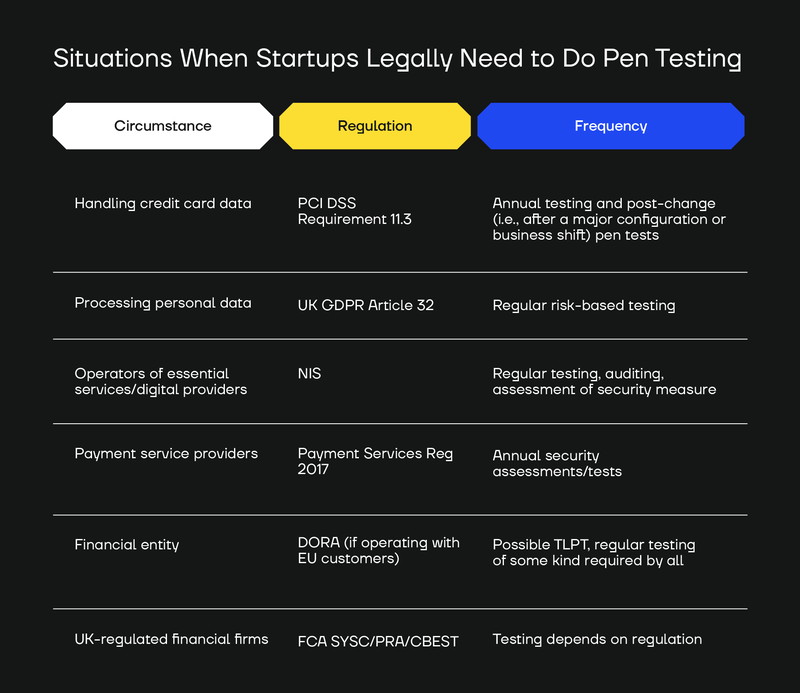
The table above shows startup pen testing laws at a glance.
The following sections cover situations where a startup may need to conduct penetration testing, either immediately or at a later stage of its company's operations.
If your company handles (or is planning on handling) credit card information
PCI DSS applies as soon as you store, process, or transmit cardholder data (the 16-digit PAN, expiration, CVV, etc.).
PCI DSS requires annual penetration testing of your systems that handle card data. SECFORCE offers PCI DSS pen testing services for startups.
Or is (or sells to) an operator of essential services/digital provider
If you plan on selling to the essential services market, prepare for either falling under or operating downstream of (i.e., selling to organisations that need to be compliant with) various NIS mandates.
These include testing for Operators of Essential Services (OES) (e.g., energy, healthcare, transport, water) and Relevant Digital Service Providers (RDSPs) (e.g., cloud providers).
NIS directives do not explicitly mandate penetration testing, but they do require appropriate technical and organisational measures, including:
- Risk analysis.
- Incident handling.
- Business continuity.
- Security testing (which can include penetration testing).
So, while pen testing is not mandated by name, it is strongly implied as part of required risk management and testing practices.
If you plan to sell into the essential services market, contact SECFORCE for more information on what your penetration testing requirements might be.
Or a payment service provider
Under the UK's Payment Services Regulations 2017, payment service providers are required to:
- Establish a risk management framework: Implement appropriate mitigation measures and control mechanisms to manage operational and security risks related to the payment services offered.
- Maintain incident management procedures: Develop effective procedures for detecting and classifying major operational and security incidents.
- Submit risk assessments to the FCA: Provide the Financial Conduct Authority (FCA) with an updated and comprehensive assessment of operational and security risks and the adequacy of mitigation measures and control mechanisms. This assessment must be submitted annually or more frequently, if directed by the FCA, in the form and manner specified by the authority.
Penetration testing is not explicitly required. However, the UK's Payment Services Regulations 2017 does require “appropriate” technical and organisational measures, and in practice, penetration testing is one of the standard measures expected for high-risk systems.
Or is in the FSI
If your startup operates within the UK's financial services sector, you may need to become familiar with the Prudential Regulation Authority (PRA) and the Financial Conduct Authority (FCA)
These regulators created the CBEST framework to test the cyber resilience of FSI firms that they think are important to the overall sector.
The CBEST framework encompasses a range of testing requirements, including intelligence-led penetration testing, which simulates real-world cyber threats to assess a firm's ability to detect and respond to attacks.
However, CBEST is typically reserved for systemically important financial institutions. Most startups are not subject to CBEST unless regulators deem them critical suppliers to the financial ecosystem.
For a comprehensive understanding of the CBEST framework and its implementation, you can read our CBEST implementation guide.
Or is a fintech or other FSI company with EU-based customers
As we explain in another blog post about the influence of EU’s DORA legislation on UK-based companies, UK firms may be covered by DORA.
This means that many UK startups will need to do DORA testing. This includes crypto brokers, insurers, and other FSI firms with EU-based customers.
SECFORCE offers a bespoke DORA consultancy service for UK-based startups.
Situations When a Startup Is Strongly Advised to Do Pen Testing
The examples in this section cover situations where penetration testing is a de facto requirement, not necessarily a legal requirement.
You want to be compliant with industry standards
Cyber Essentials (UK), ISO 27001, and SOC 2 don't make penetration testing mandatory.
But it's going to be very difficult to comply with them without doing penetration testing.
For example, with ISO 27001, penetration testing is a recommended practice for ensuring your security controls work well and that the continuous improvement process in the Information Security Management System (ISMS) is functioning.
SOC 2 doesn't mandate penetration testing, but auditors often recommend it to show that you have checked off all of the Trust Services Criteria.
For Cyber Essentials Plus (the next level of Cyber Essentials), a level of independent testing is required. This includes internal and external vulnerability scans, as well as configuration checks.
Or process personal data
The EU and UK GDPR applies to all companies processing personal data from customers and employees or doing so on behalf of other companies.
Article 32(1) of the UK GDPR says:
“A process for regularly testing, assessing and evaluating the effectiveness of technical and organisational measures for ensuring the security of the processing.”
The UK GDPR does not tell startups exactly what to test (scope) or how often to test, but it is clear that testing must be risk-based and tailored to the organisation's data processing risks. For some companies, that might mean vulnerability scans. For others, in-depth pen testing might be required.
You are selling to sensitive customers
B2B startups aiming to sell to larger businesses and enterprises will probably want to achieve and demonstrate compliance with ISO 27001, SOC 2 audits, etc.
Showing that you do pen testing (especially with a reputable UK-based pen testing partner like SECFORCE):
a) Helps you demonstrate compliance with these frameworks.
b) Is a very strong indicator of supply chain security and can help win deals from companies with a high sensitivity to supply chain risk (which is most companies in 2026).
Here are a few data points UK startups should know about how important supply chain cybersecurity is in 2026:
- 19% of CISOs cite software supply chains as posing significant security threats to their companies.
- 23% of companies say that cybersecurity is their top supply chain issue.
- Supply chain-driven cyber insurance claims were up 43% last year.
The more confident a buyer is that your company is NOT a supply chain risk in waiting, the easier it will be to onboard you into their environment.
How Often Should UK Startups Do Penetration Testing?
Startup funding is not an unlimited resource.
When funding is limited and revenue growth at all costs a requirement for the next round, pen testing can seem like an annoying cost centre. This is mostly untrue. Smart testing is a solid foundation for business success.
But what’s the minimum required to make a meaningful difference to your security?
Here’s our advice to UK startups thinking about pen testing.
Test at least annually for compliance purposes
Annual pen tests are the baseline for compliance with PCI DSS, FCA, and other standards mandating yearly testing.
Test after major changes to make breaches less likely
By major changes, we mean updates to infrastructure, the introduction of new features, or cloud migrations.
Test quarterly or more often for critical systems in startups that face extra breach risk
If you process payments, handle sensitive data, or operate in the financial services industry, quarterly tests may be required.
Generally speaking, any series of changes to your IT environment could be a basis for a new round of testing.
Before new application deployments or after config changes
Planning a product launch, new market entry, or regulatory approval? Test first.
What Kind of Penetration Testing Is Best for Startups?
It’s not a white box, black box, grey box, or any other kind of boxed testing.
The best penetration testing type for a startup is the type of penetration testing that a cybersecurity consultant advises. We 100% recommend that a startup checks with a consultant before buying penetration services to determine exactly what kind of testing makes sense for them.
But what if a startup could only do one kind of penetration testing?
We consulted our penetration team for advice on this matter. After some discussion, they agreed that for the average startup (across all sectors and business verticals), the best place to start is testing internet-facing systems that link back to sensitive data. Our article on web application testing provides in-depth details about this core testing type.
Ultimately, the best testing is not a type but whatever test is thorough enough to ensure that critical systems are safe and/or meet regulatory requirements.
SECFORCE can help startups validate their security testing and ensure their current or planned testing program meets the requirements.
Red Teaming vs Pen Testing for Startups
For most companies at the Series A funding level or below, red teaming is generally not recommended unless you’ve already done pen testing.
However, for companies selling into very tightly regulated or sensitive industries, such as defence industry suppliers, red teaming might be worthwhile.
Red teaming is the process of attacking your systems as a real-world threat actor would. The goal is to find out how well your people, processes, and technologies could resist an attack that has a specific objective.
Mature startups with Series B+ funding are also more likely to find value from red teaming as they are more likely to have the blue team expertise required to make the most of a red teaming engagement.
We explain how a startup can avoid wasting a red teaming engagement in another blog post.
SECFORCE Helps Startups Pen Test Their Systems
SECFORCE is a CREST-certified pen testing firm with over a decade of experience testing companies at every stage of growth and in every industry.
However, if you’re unsure where to begin, we also offer security consulting services. Our consulting team can give you expert pen testing advice tailored to your startup.
Whether you're considering a penetration test, looking for consulting advice, or wondering if the quotes you have received are fair, we’d love to talk to you and answer any questions about startup security.
Contact us today.
You may also be interested in...
Follow these signs to ensure your Red Team vendor is a match for your organisation.
See more
Our short list of reasons why there is no such thing as a DORA compliance checklist.
See more